

Restricted Products
Restrictions Due to Regulatory Issues
Product restrictions due to regulatory issues are based on custom regulations in the destination country. Global‑e generally initiates these restrictions at the product, category, or sometimes at the universal Harmonized Commodity Description and Coding System (HS) codes level. The HS is an international nomenclature for the classification of products. It allows participating countries to classify traded goods on a common basis for customs purposes. At the international level, the HS for classifying goods is a six-digit code system. For example:- Wooden products are regulated in Australia.
- Sunglasses required an FDA permit in the US. Merchants that do not have the required FDA permit are not allowed to sell sunglasses to the US.
Product Bundle Mapping
You can create product bundles to group products so that they can be sold together, The Product Bundle Mapping screen lets you import and process products in bundles and handle the mapping to a parent SKU on the Bundle Product Management page. This screen establishes a relationship between a bundle product that exists in the products table with the bundled child SKUs, as they are expected to pass through the Get Shipping Documents (GSD) request. To import products in bundles:- Navigate to Merchants > Product Management > Product Bundle Mapping from the top menu.
- Select a merchant from the Merchant menu.
- Download the Bundle template file by clicking File Format Example.
-
Populate the Bundle template file with the following values:
- BundleSKU - The parent SKU as it exists on the products table.
- ChildSKU - The child SKU as it should be passed by the merchant in the GSD request.
- Quantity - The quantity of the child SKU items for this bundle.
-
Fill out a row for each par or parent bundle SKU and child bundle SKU.
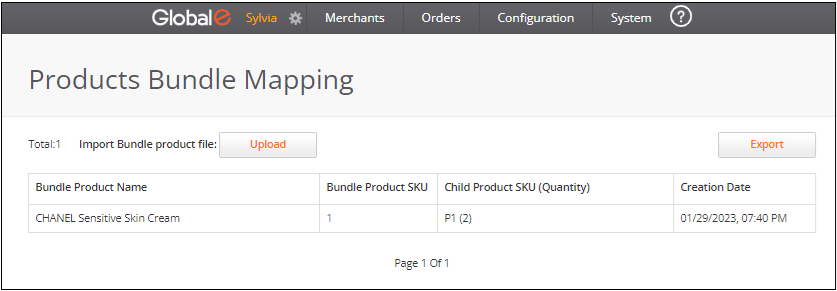
If the import succeeded, the following information is shown, containing all the saved records:
Blocked Items
Blocking Items is the Global-e capability that lets merchants prevent specific products from being purchased through Global-e — either across all Global-e operated countries or for selected destinations only. Blocking is enforced at the cart and/or checkout, and depending on the method, may also affect storefront visibility. This page consolidates the blocking-item options available across the Global-e platform. For platform-specific configuration steps, see the linked sections.When to Block an Item
Common reasons to block an item include:- Regulatory compliance - the product is restricted or prohibited from import into a destination country (for example, wooden products in Australia, sunglasses in the US without an FDA permit).
- Licensing or brand restrictions - the merchant does not have rights to sell the product internationally or in specific markets.
- Operational reasons - the product cannot be shipped via available carriers (e.g., dangerous goods, oversize), or is temporarily out of distribution.
- Strategic decisions - pricing, exclusivity, or rollout sequencing.
Restricted vs. Blocked (Forbidden) Items
A Restricted item is unavailable only for one or more selected Global-e operated countries, while a Blocked (Forbidden) item is unavailable across all Global-e operated countries. For more on restricted items, see Product Management — Restricted Products.Method Details
Catalog CSV Is Blocked Field Set on the catalog upload CSV. Values:- 0 or empty - Unblocked
- 1 - Completely restricted and blocked across all Global-e operated countries
- A newly tagged product must be added to a cart and reach checkout at least once before the restriction syncs to Global-e. To avoid the lag, send Global-e a CSV of restricted SKUs or simulate a checkout immediately after tagging.
- Restriction removal is performed via the Merchant Portal — not by simply removing the tag.
- Block a product for one or more selected Global-e operated countries.
- Block at the variant level.
- View regulatory blocks initiated by Global-e (see below) and request adjustments via your Customer Success Manager.
- Wooden products - restricted into Australia.
- Sunglasses without an FDA permit - restricted into the US.
Shopper Experience
When a blocked item is in the cart and the shopper proceeds to checkout:- Shopify (Markets method): The item is flagged on the checkout page and is removed when the shopper clicks Continue.
- Shopify (Tagging or Portal method): The item is blocked from being added to cart; if already in the cart, it cannot proceed through checkout.
- SAP Hybris (Restricted): A pop-up indicates that the product cannot be added to the cart. Attempting to check out displays the empty-cart page.
- SAP Hybris (Forbidden): A forbidden-product message is displayed on the checkout page.
- All platforms (Quantity / cart-value caps): A pop-up at checkout informs the shopper of country-specific quantity or value limits. Completion is blocked until the cart complies. See Product Quantity Restrictions.
Related Topics
- Catalog Management
- Restricting Products (Shopify)
- Product Management (Merchant Portal)
- Merchandising (SAP Hybris) - Restricted and Forbidden Products
- Product Quantity Restrictions
Managing Restricted Products
Product Restriction Management provides a centralized and transparent way to control whether products can be sold in specific destinations. It replaces fragmented, manual processes, such as tickets and spreadsheets, with a unified system that allows teams to easily view, manage, and enforce product restrictions at scale. The feature brings together both regulatory and commercial restriction signals into a single, consistent experience. Regulatory restrictions remain authoritative and read-only, while commercial restrictions can be managed directly through the Admin Portal by authorized users. This ensures that compliance requirements are preserved while still enabling operational flexibility. With Product Restriction Management, you can quickly understand why a product is restricted, when the restriction was applied, and how it has changed over time. Built-in capabilities such as search, filtering, and bulk updates (via CSV) make it easier to manage large product catalogs efficiently and consistently. By improving visibility, traceability, and control, this feature reduces operational overhead, minimizes compliance risk, and enables faster, more confident decision-making around product availability. To manage your restricted products, see the following:- Access your restricted products
- Restrict individual products
- Restrict several or all products at a time
- Restrict products in bulk
Accessing Restricted Products
This page describes how to access Restricted Products.To access Restricted Products
- Navigate to Merchants > Product Management > Product Restrictions from the top menu.
-
From the Merchant menu, select a merchant.
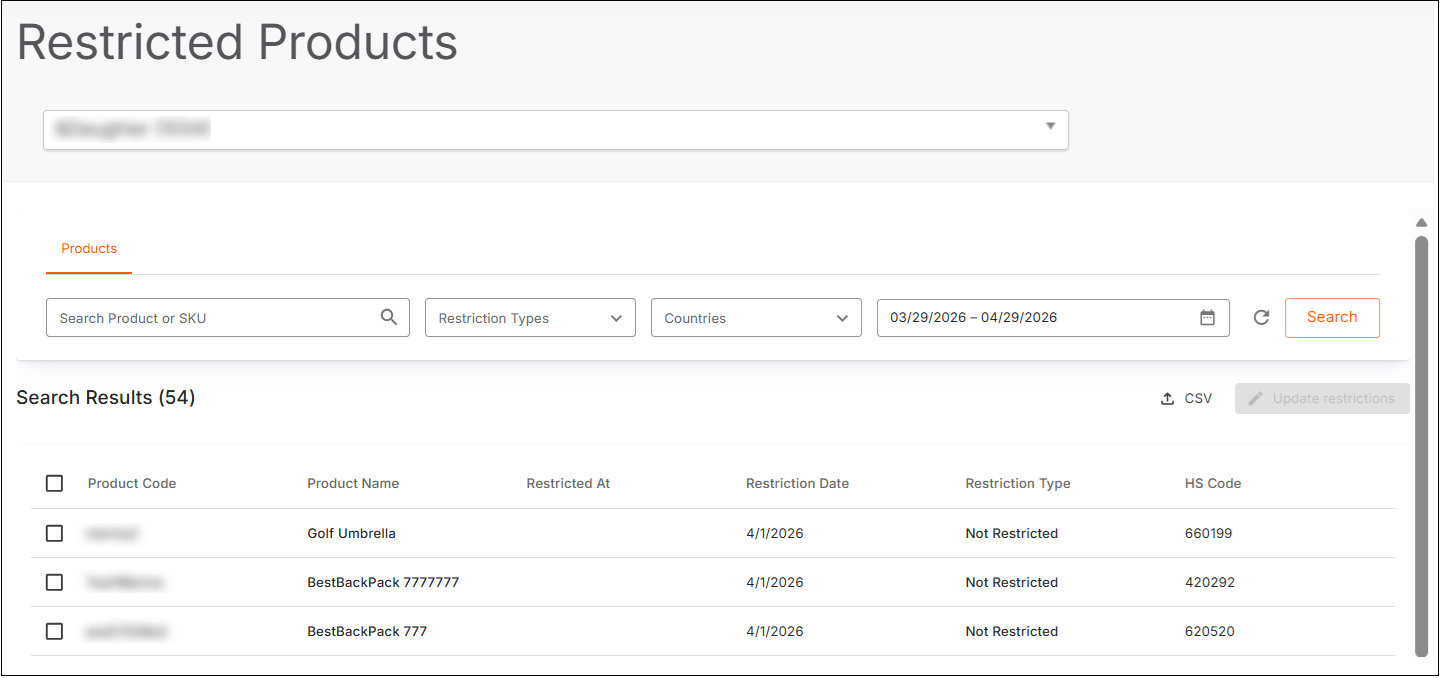
The restricted product identifier or name screen is displayed:
-
Search for your restricted product(s):
- Search Product or SKU - type part or all of the product name or SKU number.
-
Restriction Types:
- Not Restricted
- Commercial
- Regulatory
- Dangerous Goods
-
Countries:
- Click Select All to select all countries in the list
- Make individual selections
- Date range calendar - select a date range
- Click Search.The results are displayed.
Restricting Products
You can restrict products in one of the following three ways:- Restrict individual products
- Restrict several or all products at once
- Restrict products in bulk
Restricting Individual Products
This page tells you how to restrict one singular product.To restrict individual products
- Do steps 1 - 4 in Accessing Restricted Products.
- Select the product you want to restrict:
- Click Create Commercial Restriction.
- in the Products window that is displayed, click Create Commercial Restriction.
- Click Done.
Restricting Several or All Products
This page tells you how to restrict several or all products at a time.To restrict several or all products
- Follow steps 1 - 4 in Accessing Restricted Products.
-
Do one of the following:
- To restrict several products - select the checkbox next to all products you want to restrict
- To restrict all products - select the checkbox to the left of the Product Code column.
- Click the enabled Create restriction button in the top right corner.
-
In the Create restriction window that is displayed, select all the countries you want to restrict the selected product(s) from.
The countries are categorized as follows:
- EU - European Union
- EEA - European Economic Area
- ROW - Rest of World
- Click Next.
- In the Restriction reason text field, type a reason for restricting the selected product(s).
-
Click Create restriction.
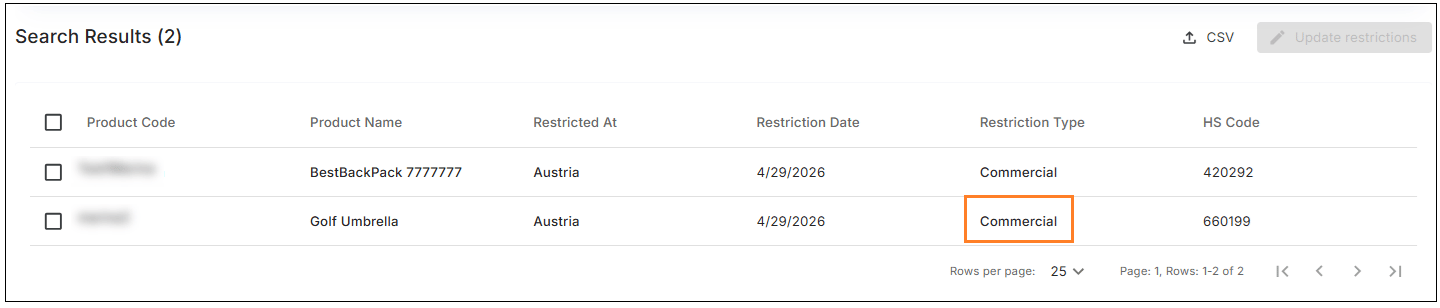
The Restriction Type of the product(s) is displayed as Commercial:
Restricting Products in Bulk
This page tells you how to restrict many products at once using a CSV bulk upload.To access restricted products in bulk
- Follow steps 1 - 2 in Accessing Restricted Products.
-
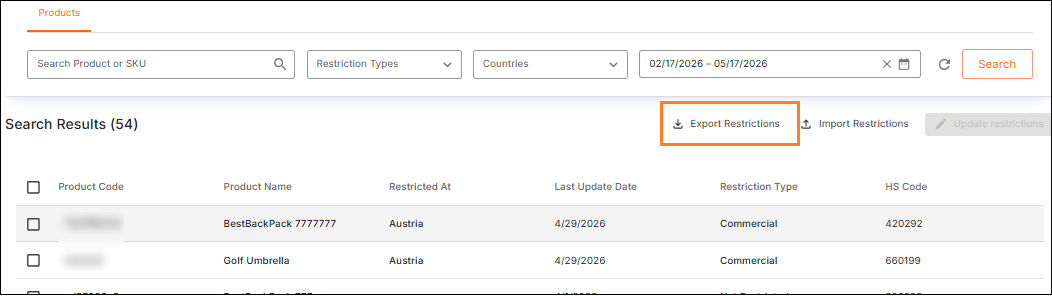
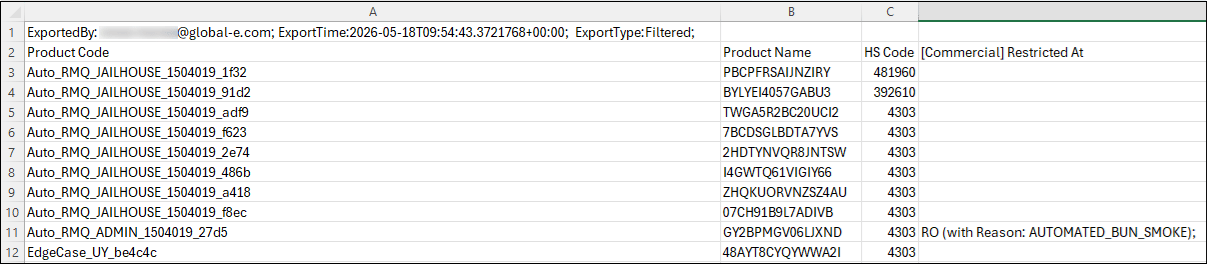
Click Export Restrictions:
-
From the Download window, select one of the following:
- Filter Data - All restriction rows that match the active filters currently applied to the grid (merchant, product, country, restriction type, data, etc).
- Selected Data - Only the rows the user has explicitly checked in the grid (via the row checkboxes).
-
Select one of the following download formats:
- CSV
- XSLX
-
In the Is Restricted column, modify the Excel sheet as needed:
- 1 = Yes
- 2 = No
A CSV file must have the following columns: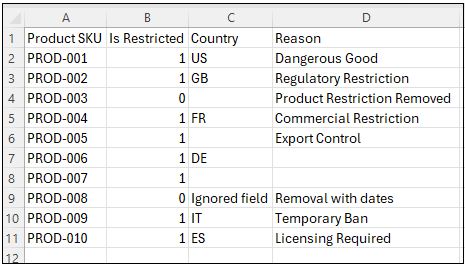
- Product SKU
- Is Restricted
- Country
- Reason
- Click Import Restrictions.The Restriction - Upload CSV window is displayed.
-
Upload the modified restrictions file from your hard drive and click Next.
The following is an example of a modified Example file prepared for import:
The restrictions file has been updated according to the parameters in the file you uploaded.
Product Price Per Currency Feed
The Product Price per Currency Feed lets you create a feed of your products with their prices in the foreign currencies of your choice. You can use this feed for your marketing needs whenever international prices are required, for example, Google shopping feed. This section describes the following:Preparing Your Product Price per Currency Feed File
- Navigate to Merchants > Product Management > Product Price Feed from the top menu.
- Select a merchant from the Select a Merchant menu.The Product Price per Currency Feed content is displayed.
- Download the SKU sample file by clicking File Format Example to the right of Browse.
-
Populate the file with the following values:
- SKU - Your product SKU as it appears on your product catalog
- Product price - Your product price in the original merchant currency (including VAT)
- Price original currency - 3-char currency code of your products
- VAT rate - The VAT rate in your country that is applicable to your product in percent (excluding the % sign)
- Save the file in the Excel, CSV, or txt format.
Generating Your Feed
To generate your feed
- Select a merchant from the Select a Merchant menu.The Product Price per Currency Feed content is displayed.
- Navigate to Merchants > Product Management > Product Price Feed.
- Click Browse and upload the file you created in Preparing Your Product Price Per Currency Feed File above.
- Click List of Currencies (or Choose) and select a currency or currencies from the Select Currencies panel.
-
Choose an output file destination to set how to receive your file containing the converted product prices:
- Download the file to your PC (one time) - Downloads and saves the file once on your PC.
- Send a daily file to this email address - Sends a file daily with updated prices to your email address.
-
Send a daily file to this SFTP site:
- Enter the server address: sftp.merchantdomain.com
- Enter the folder name.
- Enter your username.
-
Select one of the following:
- Use Password - Enter a password
- Use Private Key - Click Browseto upload your key file
- Click Generate to convert your products to the selected currency prices. If you selected to receive the file daily option, at your next login you can stop the process and generate a new file with different SKUs.